
Battery ingestion in dogs
A swallowed battery can cause a gastrointestinal obstruction and, if damaged, deep chemical injury.
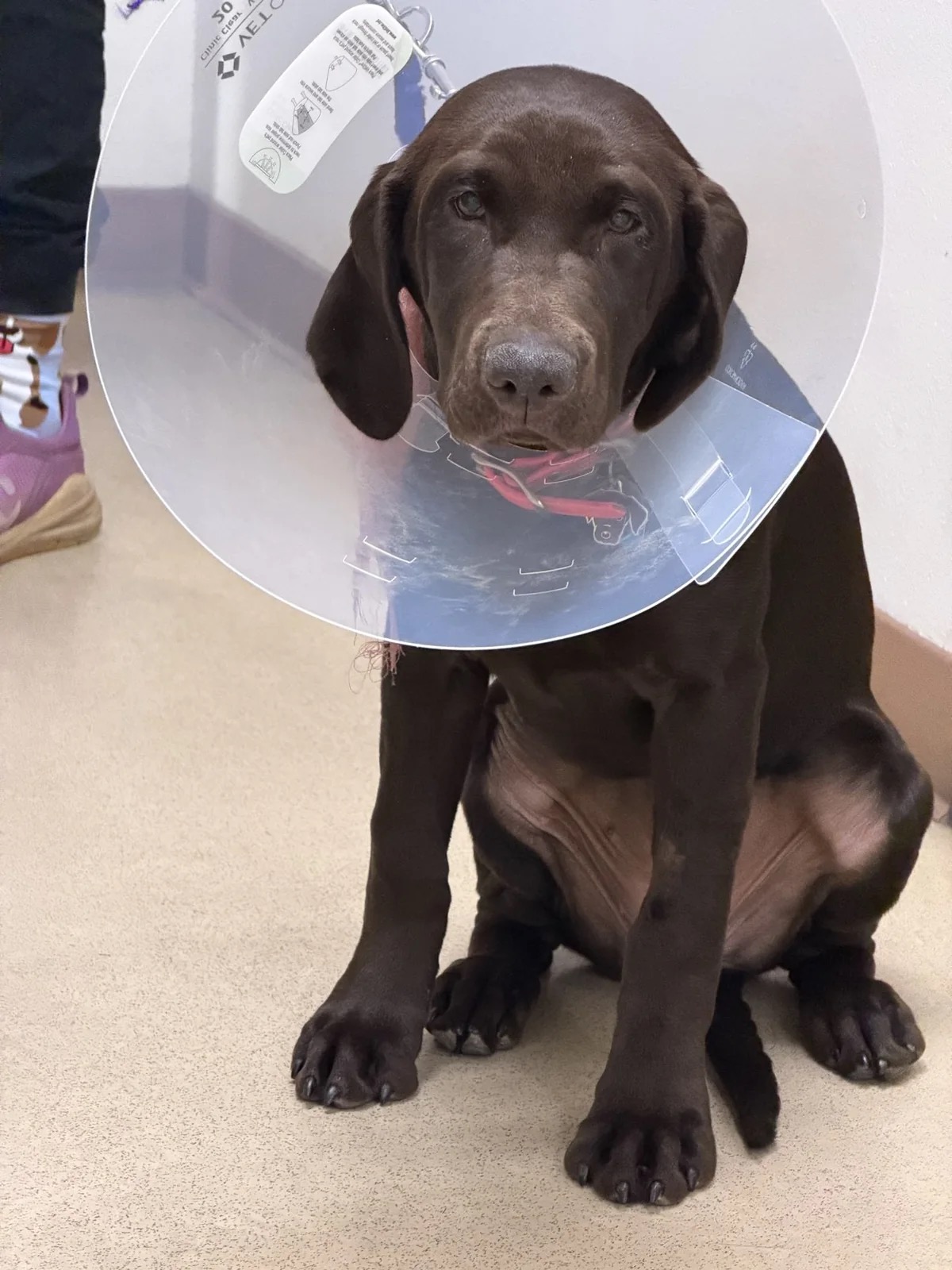
Mikayla's case
On August 12, 2026, 17-week-old Mikayla, a female chocolate Labrador retriever, was brought to Cascade Veterinary Clinics after climbing onto a nightstand and destroying a clock. Her owner searched everywhere but could not find the AA battery used to power the device. With the clock in pieces and the battery unaccounted for, there was an urgent concern that Mikayla may have swallowed it.
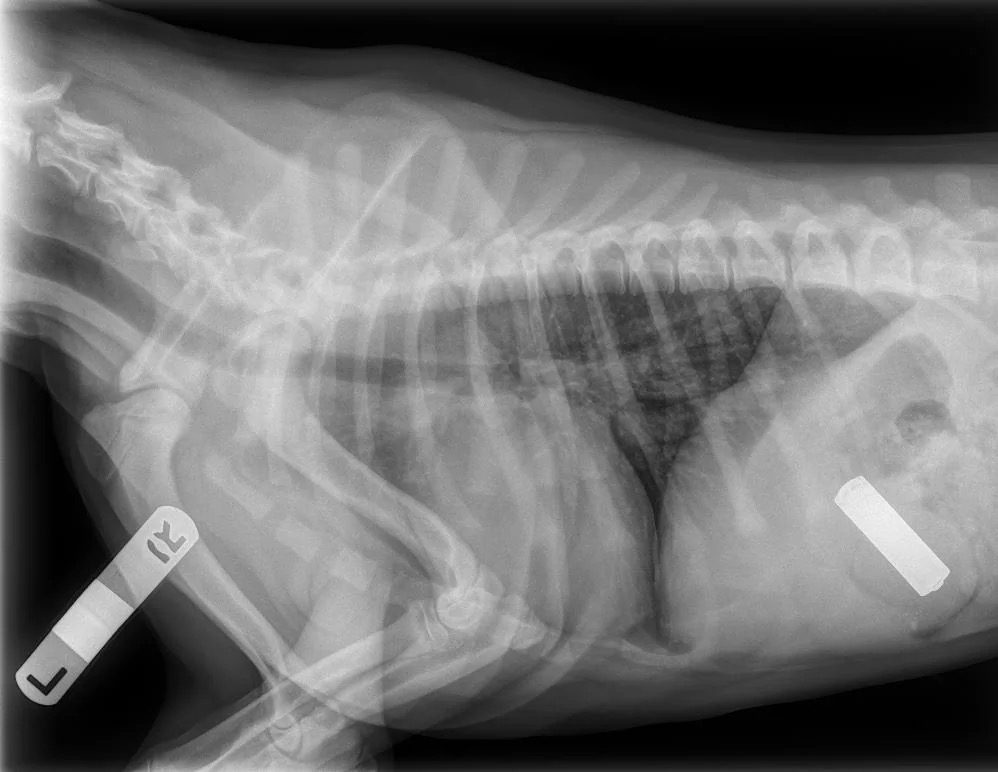
X-rays (radiographs) revealed the missing battery inside Mikayla's abdomen. Because a swallowed battery can cause both obstruction and corrosive injury, she was rushed into emergency surgery to have it removed.
Why an AA battery is more than a swallowed object
Most household alkaline batteries contain potassium hydroxide (KOH) or sodium hydroxide (NaOH). If the casing is damaged, these caustic chemicals can contact the mouth, esophagus, stomach, or intestine. They break down cell membranes and penetrate deeper into tissue—a process called liquefactive necrosis. Merck Veterinary Manual explains corrosive injury in animals.
An intact battery is still rigid. It can lodge in the esophagus or stomach, obstruct the intestine, press on tissue, or injure the digestive tract as it moves.
Some casings also contain metals, but the immediate concerns are the battery's location, casing integrity, corrosive injury, obstruction, and perforation.
“A swallowed battery is much more dangerous than a typical toy or food foreign body because it can cause serious internal damage very quickly. Batteries can leak chemicals or create an electrical reaction when they come into contact with moisture, which can burn the esophagus or stomach. Because of that, battery ingestion is considered an emergency and needs immediate veterinary attention.”
— Dr. Leah Edwards
What happens inside the body
The mouth and digestive tract are lined with moist, delicate tissue. If alkaline gel escapes, it begins damaging cells where it touches. Injury can extend below the visible surface, and its full extent may not be obvious immediately. A pet may therefore appear comfortable early or have no visible mouth burn while injury develops farther down the tract.
The battery can also interrupt the normal movement of food and fluid. Pressure on the intestinal wall can reduce blood flow. A complete obstruction can cause repeated vomiting, dehydration, electrolyte abnormalities, and progressive illness. Together, chemical and mechanical injury can lead to ulcers, tissue death, bleeding, obstruction, perforation, and infection. Tissue deprived of blood or chemically eroded can die or rupture. Leakage into the abdomen can cause peritonitis, a life-threatening inflammatory and infectious emergency.
Waiting for a battery to “pass” without veterinary direction is unsafe. The team needs to identify the battery type, whether it was chewed, where it is, whether it is moving, and whether injury or obstruction is present.
Signs may be obvious—or delayed
Possible signs include drooling, pawing at the mouth, oral pain or discoloration, gagging, repeated swallowing, difficulty swallowing, vomiting, reduced appetite, abdominal pain, lethargy, straining to defecate, or breathing difficulty. Do not wait for these signs: ulcers may not be visible for hours, and a lodged object can initially cause subtle changes.
What to do if your dog swallowed a battery
AVMA first-aid guidance advises owners to contact a veterinarian, emergency hospital, or animal poison-control center immediately after suspected poisoning and not to induce vomiting or give medication unless directed.
How veterinarians locate and retrieve a battery
The first priorities are patient stability, exposure history, an oral examination when safe, and locating the object. Batteries are usually radiopaque, so X-rays (radiographs) can show a swallowed battery's location and may be repeated to determine whether it moves. Bloodwork and other imaging may be recommended.
A suitable intact object in the esophagus or stomach may be retrieved through the mouth with a camera and specialized instruments. This requires anesthesia, expertise, and a safe object and location.
Surgery may be necessary when a battery is damaged, beyond safe endoscopic reach, obstructing the intestine, or associated with tissue death, leakage, or perforation.
Closely supervised passage is appropriate only in selected cases after veterinary assessment, often with serial imaging and clear return precautions. It is not a home decision.
Mikayla's team chose emergency surgery.
Preventing the next emergency
- Store loose and used batteries in a closed, rigid container inside a latched cabinet.
- Treat remotes, toys, flashlights, controllers, and battery-powered pet toys as access points.
- Replace devices with loose or cracked battery doors.
- Account for old and new batteries before pets return to the area.
- Secure recycling containers; “dead” batteries can retain corrosive material and charge.
- Teach “leave it” and “drop it,” but never reach blindly into a distressed pet's mouth.
Frequently Asked Questions
Should I make my dog vomit after swallowing an AA battery?
No—not unless a veterinarian who understands the exact exposure explicitly directs it. If the casing is punctured or leaking, vomiting can expose the esophagus to corrosive material.
Can I wait to see whether my dog passes the battery?
No—not without immediate veterinary assessment and an explicit monitoring plan. Although selected batteries may pass under professional supervision, owners cannot safely predict this from a dog's size, behavior, or lack of symptoms. Location, casing condition, movement, and evidence of injury determine the plan.
Does an intact battery still pose a danger?
Yes. It can lodge or obstruct, and its casing may become damaged or leak while retained. It still requires immediate veterinary assessment.
Is an AA battery the same as a button battery?
No. Both are emergencies, but cylindrical AA and coin/button batteries differ in construction, injury mechanisms, and management evidence. Do not apply child button-battery home instructions to a pet.
Why might surgery be needed instead of endoscopy?
Surgery may be safer when the battery is damaged, beyond endoscopic reach, obstructing the intestine, or associated with tissue injury or perforation.
Suspect a swallowed battery?
Call Cascade Veterinary Clinics at (509) 663-0793 and follow the team's instructions. During open hours, call ahead for urgent care. After hours, active Cascade patients begin with the same phone number and veterinary triage; do not come directly to a clinic unless instructed. Cascade is not staffed as a 24-hour emergency hospital.
Urgent veterinary care in North Central Washington · After-hours urgent care for Cascade patients
Sources
- Merck Veterinary Manual: Toxicoses From Corrosive Agents in Animals.
- American Veterinary Medical Association: Pet First Aid.
- American Veterinary Medical Association: Household Hazards.
- ASPCA Animal Poison Control: Household Battery Ingestion.
- American College of Veterinary Surgeons: Gastrointestinal Foreign Bodies.
- Cornell: Gastrointestinal Foreign Body Obstruction in Dogs.
- National Capital Poison Center: Button Battery Guideline (human comparison only).
This article provides general education and cannot diagnose or treat an individual pet.