
Canine Mobility & Comfort | North Central Washington
The strongest plan is not the one with the most products. It is the one that combines the right layers, measures the dog's real life, and changes when the dog does. Cascade's veterinary team can help you build and monitor that plan.

The short answer
Multimodal care builds a plan around the whole dog
Multimodal osteoarthritis management means combining several individualized tools instead of relying on one treatment alone. A dog's plan may include veterinary pain control, lean body condition, consistent low-impact movement or rehabilitation, safer footing and ramps at home, and scheduled rechecks. The mix changes with the dog's health, lifestyle, osteoarthritis stage, and response.
Why one treatment is rarely the whole answer
Osteoarthritis is a long-term disorder of the whole joint, and it affects more than cartilage. Pain, inflammation, muscle loss, altered movement, body condition, and the home environment can all change what a dog is able or willing to do. That is why current veterinary guidance supports a patient-specific, multimodal plan rather than one universal protocol.
Multimodal does not mean “do everything.” It means choosing useful layers, starting with the dog's most important needs, measuring response, and revising the plan. The COAST international consensus guidance describes a stage-based “base and build” approach; the 2025 review shared by Cascade's owner DVM likewise emphasizes individualized combinations of medical and non-medical care.
Already looking for signs or a diagnosis?
Cascade's existing canine osteoarthritis awareness article covers the condition and the importance of evaluation. This page starts one step later: how the parts of a long-term management plan work together after OA is suspected or diagnosed.
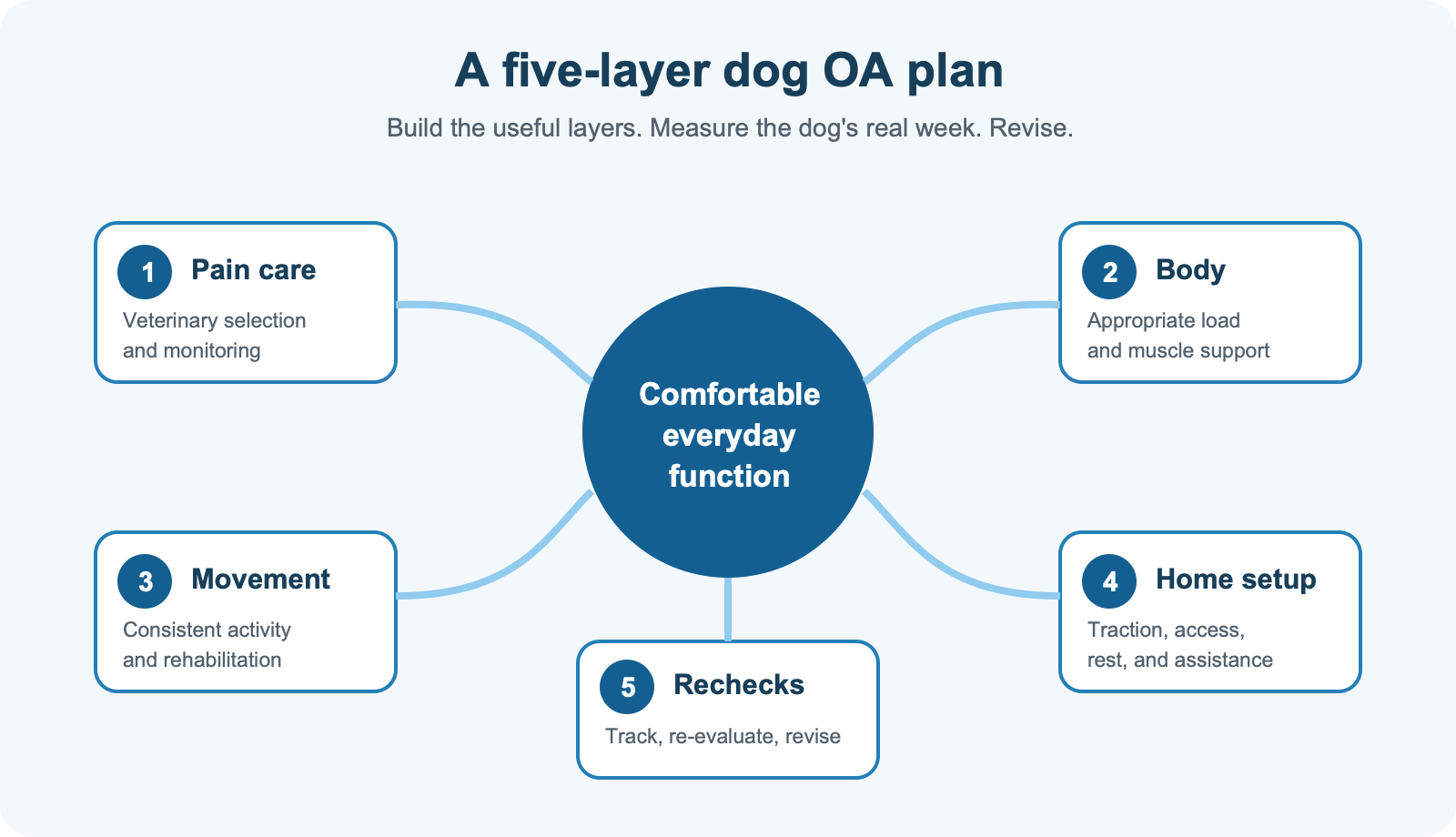
The five layers of a dog arthritis treatment plan
Not every dog needs every option, and the layers do not have to begin on the same day. Cascade's veterinary team can prioritize them around the activities that matter most to your dog and family, then use rechecks to adjust the plan as your dog's needs change.
Pain care
Choose veterinary medications or other pain-control options for the individual dog, then monitor benefits and possible adverse effects.
Body condition
Reduce unnecessary load when a dog is overweight while protecting muscle with a realistic veterinary nutrition plan.
Movement
Use consistent, controlled activity and rehabilitation when appropriate to support strength, function, and confidence.
Home setup
Add traction, stable transitions, supportive rest, and assistance where a real daily task is difficult.
Rechecks
Track meaningful activities and revise the plan when response, health, lifestyle, or disease stage changes.
Layer 1: veterinary pain control should be selected and monitored
What the conversation may include
Veterinary options can include nonsteroidal anti-inflammatory drugs (NSAIDs), a species-specific anti-nerve growth factor monoclonal antibody, other selected analgesic strategies, or surgery for particular underlying joint problems. The choice depends on the dog's exam, history, other conditions, current medications, likely benefits, and practical needs.
Cascade’s Librela service page explains appointments and ongoing monitoring. For a balanced overview of benefits, limitations, reported adverse events, and questions to ask, read our detailed Librela guide for dog owners. One product page should not be mistaken for a complete OA plan.
Why monitoring matters
“Prescription” does not mean “risk free.” Your veterinarian may recommend screening or follow-up testing, a client information sheet, and specific signs to watch. In 2025, the FDA reported safety-related Librela label changes and added owner information; the right next step is an informed veterinary discussion, not starting, stopping, combining, or substituting treatments on your own.
Never add a human pain reliever
The FDA advises pet owners to work with a veterinarian on pain medication. Ibuprofen, naproxen, acetaminophen, aspirin, and combination products can be toxic or can interact with veterinary drugs. Call before changing a dose, adding a supplement or medication, or using leftovers from another pet.
Layers 2 and 3: protect muscle while reducing avoidable joint load
Body condition is a treatment variable
If a dog is overweight, a gradual, veterinarian-guided weight plan can reduce mechanical load and may support mobility. The plan should protect nutrition and muscle rather than chase a rapid number on the scale. A dog already at an appropriate body condition does not need weight loss simply because OA is present.
Movement should be steady, not all-or-nothing
Appropriate activity helps maintain strength and useful movement. The practical target is often a repeatable amount your dog tolerates, not long inactivity followed by a strenuous weekend. Shorter controlled walks, therapeutic exercise, hydrotherapy, or other rehabilitation may be considered; evidence and suitability differ by modality, as summarized in a 2024 review of non-drug canine OA treatments.
Layer 4: change the difficult route, not the dog's whole life
Add traction where it matters
Use secured runners or non-slip mats on the path from bed to door, around food and water, and at takeoff or landing areas. Loose rugs can create a new hazard.
Reduce a hard transition
A stable ramp, step, or support harness may help with a vehicle, porch, or favorite resting place. Choose the aid with Cascade's veterinary team and train its use before relying on it.
Make rest easy to enter
Offer supportive bedding with a low edge in a comfortable, social part of the home. The best bed is one the dog can reach and get out of without struggling.
For dogs in Wenatchee, East Wenatchee, and Leavenworth, the plan should fit the surfaces and activities that make up their real week—from slick floors and winter steps to getting into the car for a Columbia River walk or a clinic visit.
Layer 5: measure function, then recheck and revise
Pain is not fully measured by an X-ray. The COAST consensus guidance notes that radiographic change and clinical function do not always match and recommends reassessment after a new treatment or when function deteriorates. Your observations can show whether the plan is improving the activities that matter.
| Activity | Describe the baseline | Track the same outcome |
|---|---|---|
| Rising after rest | How many attempts? Does the dog need help? | Time, assistance, slipping, and comfort afterward. |
| Usual walk | Which familiar route or duration stays comfortable? | Pace, pauses, lagging, gait change, and recovery later that day. |
| Stairs or porch step | Which direction is difficult, and on what surface? | Hesitation, foot placement, assistance, or route avoidance. |
| Car entry | Jump, step, ramp, lift, or refusal? | Whether the same setup requires less help and causes no delayed soreness. |
| Sleep and social activity | Restlessness, panting, isolation, or reduced play? | Settling, sleep continuity, engagement, and return to valued routines. |
A phone video from the same angle and a brief weekly note can be more useful than “better” or “worse.” Rechecks allow the team to distinguish a dose or activity issue from disease progression, a medication adverse effect, or a different problem.
A sudden change should not automatically be blamed on arthritis
Contact Cascade Veterinary Clinics or an emergency veterinary hospital promptly for a new inability to stand or walk, dragging limbs, collapse, severe or rapidly worsening pain, a hot or swollen joint, major trauma, loss of bladder or bowel control, repeated vomiting or diarrhea, black stool, marked appetite loss, seizures, or another possible medication reaction.
For an ongoing mobility concern, request an appointment. Use Cascade's current urgent and after-hours instructions when the change is sudden or severe.
This article provides general education and cannot diagnose OA, select a medication, or prescribe an exercise or weight plan.
Care built around your dog's real life
Build the smallest plan that meaningfully improves the week
A useful first visit does not have to produce a long shopping list. Cascade's veterinary team can:
- evaluate your dog's movement, joints, health history, current medications, and the activities that have become difficult;
- help prioritize pain control, body-condition support, movement, and practical home changes for your dog;
- set specific outcomes to track and recommend a recheck so the plan can change when your dog does.
Bring the medications and supplements your dog already receives, a few short videos, and three activities you most want to preserve. With locations in Wenatchee, East Wenatchee, and Leavenworth, Cascade can help turn a list of options into an individualized, monitored plan.
Frequently Asked Questions
What does multimodal osteoarthritis management mean for a dog?
It means combining several individualized tools that address different parts of the problem. A plan may include veterinary pain control, lean body condition, consistent low-impact movement or rehabilitation, safer footing and access at home, and scheduled rechecks. The mix should reflect your dog's health, activities, OA stage, and response.
Does multimodal care mean my dog needs several medications?
No. Multimodal means using more than one type of support, not automatically prescribing several drugs. Home changes, weight support, controlled activity, rehabilitation, and tracking can all be parts of the plan. Your veterinarian decides whether one medication, another option, or a combination is appropriate and how it should be monitored.
Is exercise good for a dog with osteoarthritis?
Appropriate movement usually remains important because strength and fitness support function, but the type and amount must fit the dog. Consistent, controlled activity is generally preferable to a boom-and-bust pattern. Ask your veterinarian or rehabilitation professional for a plan if your dog is painful, weak, recovering from surgery, or has another medical condition.
What home changes can help an arthritic dog?
Useful changes often include non-slip runners on slick routes, secure steps or a ramp for selected transitions, an easy-to-enter bed, raised or repositioned essentials when advised, and a support harness if your care team recommends one. Match each change to a task your dog actually finds difficult.
How can I tell whether my dog's arthritis plan is working?
Choose three to five specific activities and record the same ones each week: rising after rest, stairs, a usual walk, car entry, play, or nighttime settling. Improvement is a repeatable change in your dog's real life. Share videos and notes at rechecks so the plan can be continued, adjusted, or investigated further.
Can canine osteoarthritis be cured?
Osteoarthritis is generally a lifelong, progressive condition rather than a problem cured by one medication or supplement. Management aims to reduce pain, preserve useful movement, support quality of life, and adapt as needs change. Some dogs also have an underlying joint problem for which surgery or another targeted treatment may be discussed.
Can I give my dog ibuprofen or another human pain reliever?
Do not give a human pain reliever unless your veterinarian specifically directs it. Ibuprofen, naproxen, acetaminophen, aspirin, and combinations can cause serious harm or interact with veterinary medications. If your dog seems painful or has a possible medication side effect, call your veterinary team instead of adding or changing a drug at home.
Veterinary, peer-reviewed, regulatory, and regional sources
- Bougherara H, Boukhechem S, Dib AL. A multimodal approach to Canine Osteoarthritis management: A state-of-the-art. Open Veterinary Journal. 2025;15(11):5461-5465.
- Cachon T, Frykman O, Innes JF, et al. COAST Development Group's international consensus guidelines for the treatment of canine osteoarthritis. Frontiers in Veterinary Science. 2023;10:1137888.
- Merck Veterinary Manual. Osteoarthritis in Dogs and Cats. Current page accessed July 29, 2026.
- Pye C, Clark N, Bruniges N, Peffers M, Comerford E. Current evidence for non-pharmaceutical, non-surgical treatments of canine osteoarthritis. Journal of Small Animal Practice. 2024;65(1):3-23. doi:10.1111/jsap.13670.
- Barbeau-Grégoire M, Otis C, Cournoyer A, et al. A 2022 systematic review and meta-analysis of enriched therapeutic diets and nutraceuticals in canine and feline osteoarthritis. International Journal of Molecular Sciences. 2022;23(18):10384.
- U.S. Food and Drug Administration. Get the Facts about Pain Relievers for Pets. Current page accessed July 29, 2026.
- U.S. Food and Drug Administration. Animal Drug Safety-Related Labeling Changes: Librela, February 18, 2025. Accessed July 29, 2026.
- Washington State University Veterinary Teaching Hospital. Acupuncture for chronic pain in dogs. March 5, 2026.
- Cornell Richard P. Riney Canine Health Center. Osteoarthritis. Updated December 9, 2025; accessed July 29, 2026.
This client-education article summarizes evidence and guidance; it does not replace an examination, diagnosis, or an individualized treatment plan.